Finding an ancestor’s birth record can feel like reaching the end of a search. You have the name, the date, the parents, and perhaps finally the Italian town your family came from. But there is another detail hiding in many old records that is easy to overlook: the address. A street name and house number may seem secondary compared with a birth, marriage, or death, but an address can open an entirely different way of looking at your family’s history. Your ancestors did not simply live in a comune. They lived on a particular street, in a particular building, surrounded by particular people, and sometimes those people appear in the records too.
Finding the comune is one of the most important breakthroughs in Italian genealogy. It changes a search for someone “from Italy” into a search in a specific community with its own civil records, churches, neighborhoods, and families. An address takes that idea one step further. Instead of knowing only that an ancestor lived in Napoli, for example, a record may identify the section of the city, the street, and sometimes even the building number connected with an event. Suddenly the family story becomes much more physical. This was not simply where an ancestor was registered. It was a place where people slept, ate, worked, raised children, received visitors, and experienced the ordinary events that eventually became family history.
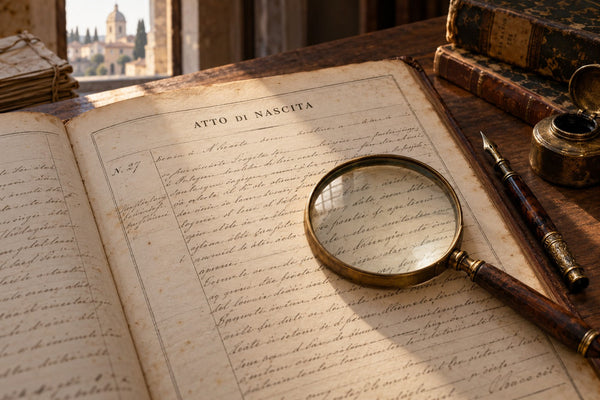
When people first begin researching Italian records, they naturally search for familiar names. But once you find the correct record, slow down and look beyond the name you were searching for. Depending on the period and type of document, an Italian civil record may contain information about parents, occupations, residences, witnesses, declarants, and other people associated with the event. An address appearing in that record should not automatically be treated as decoration. Write it down exactly as it appears, and then look for it again.
This is where an interesting change in perspective occurs. Genealogy usually begins with people: Who were Giuseppe’s parents? Who did Maria marry? Where was Francesco born? Once an address is known, however, you can reverse the search. Instead of asking only where a person lived, you can begin asking who else appears at that address. Another birth may have occurred there. A death record may identify someone residing there. Another family with a completely different surname may repeatedly appear at the same location. A person who initially looks unrelated may later appear as a witness, relative, neighbor, or other connection in another record. One document may not explain the relationship, but several documents sometimes can.
This can be particularly revealing when researching families in cities. A single address did not necessarily mean a single nuclear family occupied an entire building. Depending on the place and period, multiple households or unrelated individuals could be associated with the same property. Sharing an address therefore does not prove that two people were related, but it does provide another piece of evidence. If two surnames repeatedly appear at the same address and then appear together again as witnesses, marriage connections, or relatives in later records, the pattern becomes more interesting. The address becomes a point connecting records that might otherwise have been researched separately.
Family history is naturally focused on direct ancestors—parents, grandparents, and great-grandparents—but our ancestors did not live in isolation. They had siblings, cousins, neighbors, landlords, employers, midwives, witnesses, friends, and people whose precise relationship may have disappeared from family memory. Some of those people may appear repeatedly in surviving records. A witness at one marriage might later appear at another family event. A midwife might have delivered several children in the same neighborhood. A surname that seems unfamiliar might eventually turn out to belong to a married sister or maternal relative. The more completely we reconstruct the world surrounding an ancestor, the better chance we have of understanding the ancestor himself.
Historical addresses also require caution. Street names can change, buildings can be renumbered, neighborhood boundaries can shift, and a street may disappear entirely as a city develops. Spelling can vary from one handwritten record to another as well. Two addresses that look slightly different should not automatically be assumed to be different places, but similar-looking addresses should not automatically be declared identical either. As with names, dates, and relationships, the evidence has to be compared.
Once several records have been found, addresses can also reveal movement. A couple may appear at one address when their first child is born and another several years later. A widowed parent may later appear at the home of an adult child. A family may move from one section of a city to another, while someone who disappears from one comune may later appear in records from a nearby community. Placed in chronological order, those addresses can become a kind of map of a family’s life. The family tree tells you who. The addresses begin telling you where.
The next time you find an Italian birth, marriage, or death record, resist the temptation to extract the names and immediately move on. Look at the rest of the page. Write down the occupation, the witnesses, and the address, and then ask whether that same place appears anywhere else in the family’s records. You may discover that the most interesting clue on the document was not the surname you spent months searching for. It was the street underneath it. Finding the comune tells you where your family came from. Finding the address can bring you one step closer to understanding how they actually lived.
_____________________________________________________________________________________________
About the Author
Marc Aitelli is the founder of Castellesi, an Italian-American heritage brand inspired by family, ancestry, and the towns and comuni that connect generations to Italy.