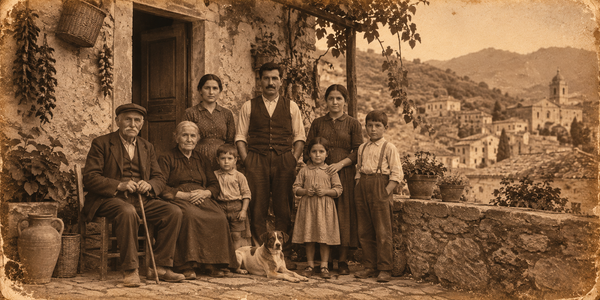
Almost every Italian-American family has heard some version of it. Great-grandpa stepped off the boat, an inspector couldn't spell his name, and in a single moment at Ellis Island the family became someone else. It is one of the most repeated stories in American immigration history, and it is passed down with total confidence at dinner tables everywhere. The trouble is that the records almost never support it. And understanding why is one of the most useful things you can learn if you want to find where your family actually came from.
The list was written before the ship ever sailed
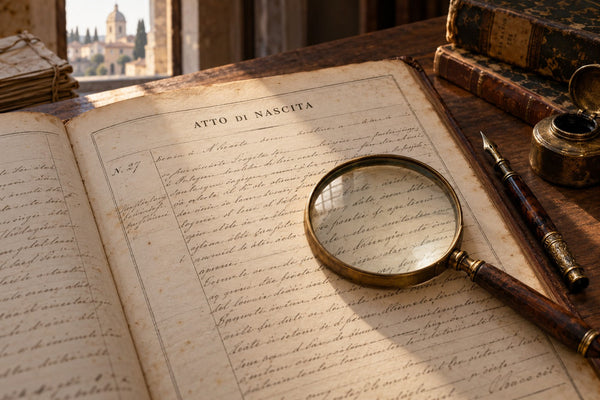
The key to the whole story is a document most families have never looked at closely: the passenger manifest. Italian emigrants did not arrive in New York and give their names for the first time to an American official. Their names had already been written down in Europe. Shipping companies compiled the passenger lists at the port of departure, in Napoli, Palermo, Genova and elsewhere, as passengers bought tickets and boarded. The clerks writing those lists were often Italian themselves, working from tickets and documents, and the names were recorded the way they were spelled at home.
That list then crossed the ocean with the ship. When passengers reached Ellis Island, inspectors worked from the manifest that was already in their hands. Their job was to check each person against the list, ask questions, and decide whether that person could be admitted. They were not writing new names, and they were not creating new records from scratch. Interpreters who spoke Italian and its regional dialects were on hand for exactly that reason.
So where did the names actually change?
Many Italian-American surnames did change, and many first names changed even more often. Giuseppe became Joseph, Gaetano became Guy, Carmela became Millie. Surnames lost a vowel, gained a letter, or were shortened. But those changes usually happened later, and gradually, after the family had already settled in America.
Some changes came at naturalization, when an immigrant filed papers to become a citizen and sometimes chose an Americanized version of the name. Some happened at school, where a teacher simplified a child's name and it stuck. Some happened at work, on payrolls and union cards. Some were simply decisions families made to fit in, or to avoid the prejudice Italian immigrants faced. And some were slow drift: the same family appearing in census records, city directories and church registers with three or four slightly different spellings over twenty years.
The Ellis Island story survives partly because it is simpler than that reality. It gives one dramatic moment to something that actually happened slowly, in many places, through many small choices.
What the manifest tells you instead
Once you stop thinking of the manifest as the place where your name was lost, you can see it for what it really is: one of the richest documents in Italian-American genealogy. Depending on the year, a manifest can record a passenger's age, sex, marital status and occupation, whether they could read and write, their last permanent residence, and their final destination in America.
The last permanent residence is often the single most important line on the page. It names the town your ancestor left. For a family that only ever said "we're from Avellino" or "from near Naples," this column can turn a whole province into one specific comune, and the comune is where the Italian civil records are kept.
Manifests from the 1890s onward also ask whether the passenger was joining a relative or friend in America, and if so, who and where. That name can lead you to a brother, a cousin, or a future spouse already living in Brooklyn or New Jersey. From 1907, manifests also record the nearest relative left behind in the home country, with a town. That is two more names, and often a second confirmation of the comune.
Age and occupation matter too. An age gives you an approximate birth year to search in the Italian records. An occupation, contadino, muratore, calzolaio, can help you tell apart two men with the same name from the same town.
How to find the original spelling
If your family's name changed in America, the goal is to work backward to the spelling that appears in Italy. Start with what you know for certain: the name used in the earliest American records you can find, such as naturalization papers, early census entries, church records and marriage certificates. Look at every variation, not just the one the family uses today. Then look for the manifest using the approximate year of arrival and the first names, ages and hometown hints you have, rather than relying only on today's surname.
When you find the manifest, copy the name exactly as it is written, including any spelling that looks wrong to modern eyes. That spelling, together with the town in the last-residence column, is your bridge to the Italian civil records. Find the original spelling, and you can find the comune.
The real story is better
It is easy to understand why the Ellis Island myth lasts. It is a good story. But the real one is more interesting, and far more useful. Your ancestor's name was not taken from them by a stranger in a hurry. It was written down in their own country, carried across the ocean, and preserved on a list that still exists. Somewhere in that list is the name of the town they left behind.
If you are stuck on a spelling or can't find your family's manifest, Ask Orso. Tell us what you know, and we'll help you trace it back to the place your family came from.
_____________________________________________________________________________________________
About the Author
Marc Aitelli is the founder of Castellesi, an Italian-American heritage platform inspired by family, ancestry, and the towns and comuni that connect generations to Italy.