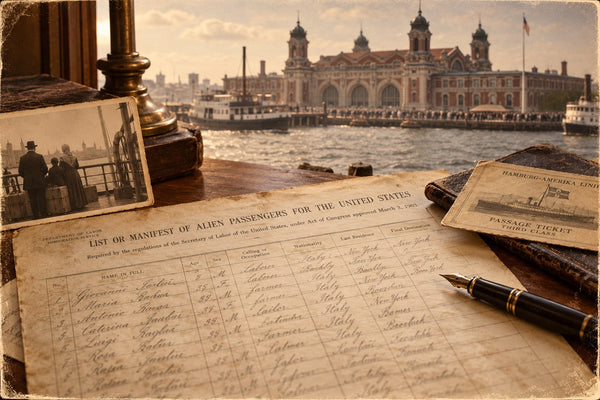
talian-American family stories usually begin with the person who left. A young man boards a ship in Napoli. A daughter says goodbye to her parents. A family arrives in New York carrying a few possessions and the hope of building something better. We follow them across the Atlantic, searching passenger manifests, naturalization papers, and census records to learn where they lived, whom they married, and what became of their children in America. But every departure created another story: the story of the people who stayed behind.
When an ancestor left Italy, an entire family did not necessarily leave with them. Parents remained, as did brothers, sisters, grandparents, cousins, childhood friends, and neighbors. Sometimes one sibling emigrated while another remained with aging parents. Sometimes several members of a family left over a period of years. Some people went to America, returned to Italy, and later crossed the Atlantic again. The neat line we draw on a family tree rarely captures how complicated those decisions were. For the people involved, immigration was not simply movement from one country to another. It was separation.
When we follow only the immigrant branch, it is easy to unconsciously imagine the Italian side of the family stopping at the moment our ancestor departed. It did not. A brother who remained in Italy married. A sister had children. Those children had children of their own. Families changed houses, occupations, and communities. Some stayed in the same town for generations, while others moved elsewhere in Italy. While one branch of the family was becoming Italian American, another branch continued its life in Italy. Both are part of the same family history.
Generations later, immigration can sound almost inevitable. Our ancestor “came to America.” But imagine the event from the other side. A mother watched a son leave for a country she might never see. Brothers and sisters said goodbye without knowing when, or whether, they would be together again. A person who appears to us as the founder of an American branch of the family was still somebody’s child, sibling, cousin, or friend. Looking at immigration from Italy rather than from America changes the story. The ship’s departure was not only a beginning. For someone standing on the other side, it was also an absence.
Distance did not necessarily mean the end of family relationships. Letters crossed the Atlantic, photographs were exchanged, and money earned abroad could be sent home. News of births, marriages, illnesses, and deaths traveled between relatives. Some immigrants returned to visit, others eventually returned permanently, and additional relatives sometimes followed the same path to America years later. These connections could continue for decades, even as children were born who had never met relatives on the other side of the ocean. That is one reason family research should not automatically stop once the immigrant is located. The people around that immigrant may explain what happened next.
This is something I understand through my own family. Emma came from Castel Baronia in the province of Avellino, while Armando came from Nocera Inferiore in the province of Salerno. They eventually built their lives in America, and it would be easy to tell their story entirely from that point forward: immigration, marriage, children, and the generations that followed in the United States. But their departure did not erase the families they came from. In Castel Baronia, Emma belonged to a family of sixteen children. Her parents, Maria Raphaela Lombardi and Francesco Paolo Morra, had built a family whose branches would extend in many directions. In Nocera Inferiore, Armando likewise belonged to a family and community whose history did not end when his life continued across the Atlantic. Those branches matter because they are not merely historical. Our family remains connected with relatives in Castel Baronia and Nocera Inferiore today. The Atlantic separated branches of the family. It did not end the family.
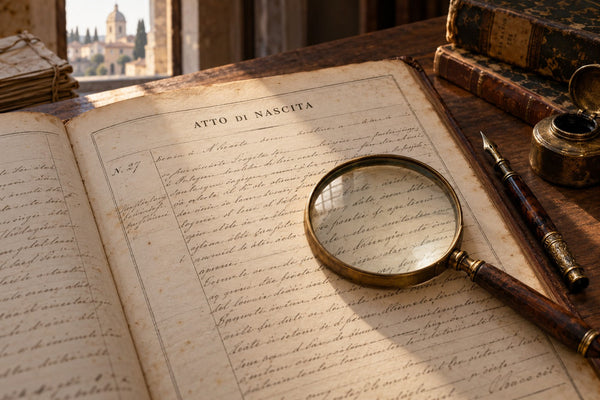
Genealogy is usually described as a search backward through generations, but there is another useful direction: sideways. Once you identify an Italian ancestor’s parents, identify all of their children, not only your direct ancestor. Follow the brothers and sisters. Determine who emigrated and who remained. Look at their marriages and follow their children. Those collateral branches can reveal relatives you never knew existed, but they can also solve problems in your direct line. A sibling’s marriage record may contain information missing from your ancestor’s record. A relative’s passenger manifest may preserve a hometown more clearly. A cousin may have remained in the ancestral comune and created a family line that continues there today. Sometimes the way forward in genealogy is not another generation backward. It is the family standing beside your ancestor.
This is another reason the exact Italian comune matters so much. A surname alone can spread across regions and provinces, while a specific town creates a much narrower world. Once you know the comune, you can begin reconstructing the family as a community rather than simply a chain of ancestors. Who remained there? Which surnames repeatedly married into the family? Which relatives lived nearby? Which branches disappeared from the records because they moved elsewhere? Which branches are still there? The ancestral town becomes the place where the American and Italian sides of the family story meet.
There is something extraordinary about discovering that relatives still live in a town an ancestor left generations ago. For many Italian Americans, Italy can initially feel like history—a place belonging to grandparents and great-grandparents. Then suddenly there is a living person on the other side of the family tree, someone whose great-grandparent and yours were siblings, someone who may know a story your branch forgot, or someone who walks streets your ancestor once knew. The family history stops being entirely about the past.
Passenger manifests are powerful records because they document movement, but a ship manifest captures only one moment: someone left. To understand what that departure actually meant, we have to look in both directions. Follow the immigrant into America and learn where they lived, how they worked, whom they married, and what became of their children. But then look back toward Italy. Find the parents who remained, the brothers and sisters, and the branches that never crossed the Atlantic. The Italian-American story was never simply the story of people leaving Italy. It was the story of families continuing on both sides of the ocean, and sometimes, generations later, those two sides find each other again.
_____________________________________________________________________________________________
About the Author
Marc Aitelli is the founder of Castellesi, an Italian-American heritage brand inspired by family, ancestry, and the towns and comuni that connect generations to Italy.