The Patron
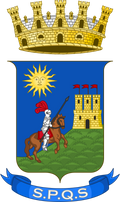
Maria Santissima del Soccorso
Maria Santissima del Soccorso is Sciacca's patron, with feast dates of 2 February and 15 August. No further explanation of the two observances.

 — Castellesi

Sciacca rises in terraces above a working fishing harbour on the south-western coast, between Agrigento and Selinunte, with thermal springs that have been used since antiquity.
For a researcher it has a role beyond its own descendants: Sciacca is the seat of a section of the State Archive , and part of the province's documentation is held here rather than in the provincial capital.


Italian is standard. Sicilian is widely represented in local speech and culture.
The hot springs of Monte Kronio above the town were used in antiquity and gave Sciacca its earliest importance; the vapour caves in the mountain are among the oldest known thermal sites in the Mediterranean. The Arabs developed the town, and the name derives from their form of it.
Under the Normans and after, Sciacca prospered as a port shipping the grain of the interior. Its most notorious episode is the Caso di Sciacca , a feud between the Perollo and Luna families that ran through the fifteenth and sixteenth centuries and repeatedly convulsed the town — an event still part of local memory.
The town developed a majolica tradition of real standing, and ceramics are still made and sold here.
Under the Bourbons Sciacca was a district seat of the Valle di Girgenti. Its fishing fleet grew through the nineteenth and twentieth centuries into one of the more important on the southern coast, and fishing remains the town's defining trade.
In 1831 an island rose from the sea off this coast in a volcanic eruption — claimed by Britain, France and the Kingdom of the Two Sicilies before it sank again within months. Ferdinandea is still a shoal, and still occasionally disputed.


Carry your heritage with pride. Timeless designs inspired by the heart of Agrigento.
SHOP THE COLLECTION →


Discover the beauty, culture and traditions of Agrigento and its remarkable comuni.
EXPLORE AGRIGENTO →From the mountains to the sea, Sicilia is a region of history, flavor and soul.
EXPLORE SICILIA →From the passenger index
At least 8,284 people who gave Sciacca as their home are recorded by name among Italian arrivals in the United States — each with the ship they sailed on and the day they landed.
A floor, not a total. The index covers arrivals through 1912, holds nothing between May 1907 and December 1911, and many passengers were written down with no home town at all. Where a name is there, it is there with its record.
Have Orso look for your family →The nearest major airport is Palermo, Catania, Trapani, or Comiso Airport, depending on the destination.
Sciacca is a real town rather than a resort — a fishing port with a handsome upper town, ceramics workshops along its streets, and thermal springs above.
For a descendant it is easy to walk and easy to read: the harbour, the terraces climbing away from it, the churches of the old quarters. If your family were fishermen, the port at dawn is the most honest thing to see.
Selinunte is half an hour west and is among the largest Greek sites in the Mediterranean. Agrigento and its temples are about an hour east, and the archive's Sciacca section is in the town itself.
The harbour — the working fishing port at the foot of the town.
The upper town — the terraces, the Duomo, and the palazzi of the Perollo and Luna families.
The ceramics workshops — the majolica tradition, still practised.
Monte Kronio — the thermal caves above the town.
Il Carnevale — in February, if your timing allows.
Selinunte — the Greek city half an hour west.
Your family's parish — the record-keeping institution before 1820.
Archives and registers
Sciacca has its own archive section — ask there if Agrigento comes back empty.
The journey does not end at the boundary of one comune. The province, the region and the neighbouring towns often hold the rest of the picture.

Sciacca is more than a place on a map. It is a part of you.
FIND YOUR COMUNE →