The Patron
San Giovanni Battista
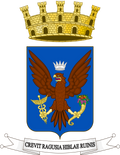
San Giovanni Battista is the listed patron, celebrated on 29 August. San Giorgio belongs specifically to Ragusa Ibla, while San Giovanni identifies Ragusa Superiore.

 — Castellesi

Ragusa sits on the Hyblaean plateau in the far south-east of Sicily, split into two towns on two ridges — Ragusa Ibla , the medieval town rebuilt in place after 1693, and Ragusa Superiore , built new on the hill above.
The province is one of the youngest in Italy, created in 1927 . But the territory it covers is one of the oldest coherent units on the island: the Contea di Modica , a feudal state that ran its own affairs for centuries.


Italian is standard. Sicilian is widely represented in local speech and culture.
For four centuries this corner of Sicily was the Contea di Modica , the largest and most powerful feudal state on the island — effectively a country within the kingdom, with its own administration, its own courts and a degree of autonomy no other Sicilian territory had. Modica was its capital, and Ragusa one of its towns.
That history explains the character of the whole area: a dense network of substantial, prosperous towns rather than a single dominant city, and a strong local identity that predates any modern province.
On 11 January 1693 the great earthquake of the Val di Noto destroyed everything. What the towns did next divided them. Ragusa split : part of the population rebuilt in place, on the old ridge — Ragusa Ibla — and part built a new town on the plateau above, Ragusa Superiore . For a period the two were separate comuni , reunited later. Modica, Scicli, Comiso and the rest rebuilt in the same unified late baroque that makes the Val di Noto a UNESCO site.
In the nineteenth and twentieth centuries the area prospered by Sicilian standards — agriculture on the plateau, asphalt quarrying, and later oil at Ragusa, the first commercial oilfield in Italy.
On 2 January 1927 twelve comuni of the old county were detached from Siracusa to form the province of Ragusa, promoted by the Fascist deputy Filippo Pennavaria .


Carry your heritage with pride. Timeless designs inspired by the heart of Ragusa.
SHOP THE COLLECTION →


Discover the beauty, culture and traditions of Ragusa and its remarkable comuni.
EXPLORE RAGUSA →From the mountains to the sea, Sicilia is a region of history, flavor and soul.
EXPLORE SICILIA →From the passenger index
At least 1,126 people who gave Ragusa as their home are recorded by name among Italian arrivals in the United States — each with the ship they sailed on and the day they landed.
A floor, not a total. The index covers arrivals through 1912, holds nothing between May 1907 and December 1911, and many passengers were written down with no home town at all. Where a name is there, it is there with its record.
Have Orso look for your family →Comiso Airport is a common gateway.
Ragusa is one of the most rewarding towns in Sicily and one of the least crowded. Ibla , on its ridge, is the baroque town rebuilt in place after 1693 — dense, steep and beautiful. Superiore , above it, is the newer town, and the walk or the long stair between them is the best way to understand what happened in 1693.
For a descendant the province is compact enough to cover properly. Modica is twenty minutes, Scicli and Comiso not much further, and the coast is close. If your family were from one of the twelve comuni, all of them are within an hour.
The plateau between the towns — dry-stone walls, carob trees, low farmhouses — is the landscape they worked, and it has changed less than most of Sicily.
Ragusa Ibla — the lower baroque town, and the Duomo di San Giorgio.
Ragusa Superiore — the upper town, and the cathedral of San Giovanni Battista.
The stair between them — the clearest illustration of the 1693 split.
Modica — the county's historic capital, its baroque churches and its chocolate.
Scicli and Comiso — the other Val di Noto towns of the province.
The Hyblaean plateau — dry-stone country, and the landscape of the old county.
Your family's parish — and note which of the two Ragusas it was in.
Archives and registers
The province was created in 1927. Everything earlier is under Siracusa — or Noto.
The journey does not end at the boundary of one comune. The province, the region and the neighbouring towns often hold the rest of the picture.

Ragusa is more than a place on a map. It is a part of you.
FIND YOUR COMUNE →