The Patron
San Giacomo
San Giacomo il Maggiore is Caltagirone's patron, celebrated on 25 July. Local tradition includes the illumination of the Scala di Santa Maria del Monte with thousands of oil lamps during the feast.

 — Castellesi

Caltagirone sits inland on the hills above the Piana di Catania, a Baroque town rebuilt after the earthquake of 1693 and famous for a single trade: ceramics , worked here for a thousand years and still worked now. Its monumental stair of 142 tiled steps is the most recognisable object in the province.
For a researcher, one archival fact outranks everything else on this page. Caltagirone's post-unification civil registers are explicitly excluded from the Archivio di Stato di Catania's main holding. They sit at the archive's own Sezione di Caltagirone , together with those of ten neighbouring comuni. If you have searched Catania and found nothing, that is almost certainly why.


The local speech is Sicilian, south-eastern inland variety, locally calatino.
Ceramics here go back to antiquity, and the trade was protected early: Alfonso of Aragon granted the town's craftsmen exemption from customs duties, which let Caltagirone ware circulate freely and sell across the Mediterranean. The pieces of the fifteenth, sixteenth and seventeenth centuries decorated aristocratic houses and churches all over Sicily.
Almost none of that survives, and the reason is the ground. A serious earthquake struck in 1542 . Then, on 11 January 1693 , the Val di Noto earthquake destroyed the town — buildings, churches, and centuries of accumulated work.
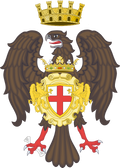
What is remarkable is what the reconstruction chose to do. Rather than start over, Caltagirone kept its late-Renaissance plan: a crux viarum , the cross of streets formed vertically by the Scala di Santa Maria del Monte and horizontally by the streets of San Giorgio and San Giacomo — the same cross that appears on the civic arms. The Baroque town was built onto that skeleton, and it earned Caltagirone inscription on the UNESCO World Heritage list in 2002 , alongside Catania, Militello, Modica, Noto, Palazzolo Acreide, Ragusa and Scicli.
The stair itself was raised in the first decade of the seventeenth century — sources give 1606 or 1608 — to link the old upper town to the new lower one: 142 steps climbing some 130 metres of slope. Its famous ceramic risers are modern, laid from 1953–54 by the MAC cooperative, with designs running historically from the oldest styles at the bottom to the most recent at the top.
The ceramic revival that made those tiles possible is owed to Don Luigi Sturzo , the Caltagirone priest who was mayor of the town and later founded the Partito Popolare Italiano. He worked to restore the industry, and pushed for the Museo Regionale della Ceramica , whose collection was assembled from 1948 . From the early nineteenth century the town had also developed a distinct speciality in figurines — Giacomo Bongiovanni modelling the faces and gestures of ordinary Sicilians, peasants, shepherds, musicians, brigands, for the crib scenes still made here.


Carry your heritage with pride. Timeless designs inspired by the heart of Catania.
SHOP THE COLLECTION →


Discover the beauty, culture and traditions of Catania and its remarkable comuni.
EXPLORE CATANIA →From the mountains to the sea, Sicilia is a region of history, flavor and soul.
EXPLORE SICILIA →From the passenger index
At least 556 people who gave Caltagirone as their home are recorded by name among Italian arrivals in the United States — each with the ship they sailed on and the day they landed.
A floor, not a total. The index covers arrivals through 1912, holds nothing between May 1907 and December 1911, and many passengers were written down with no home town at all. Where a name is there, it is there with its record.
Have Orso look for your family →The nearest major airport is Catania Fontanarossa Airport.
Caltagirone is inland and upland, a drive rather than a train ride from the coast, and the town is organised vertically. The Scala di Santa Maria del Monte is both the main sight and the main street: 142 tiled steps climbing from the lower town to the old fortified quarter at the top, where the Norman castle and the medieval walls once stood.
At the summit, Santa Maria del Monte was the town's original mother church, rebuilt after 1693, and holds a twelfth-century Byzantine icon. At the other end of the axis, the Cattedrale di San Giuliano is Norman in origin, rebuilt after the earthquake, with an early twentieth-century Liberty facade and a dome faced in local ceramic.
For a descendant, the Museo Regionale della Ceramica is the one museum that is genuinely about your family rather than about art history — around 2,500 pieces, assembled from 1948, covering exactly the trade most Caltagironesi worked in.
Archives and registers
Sicilian civil registration starts in 1820. And for Caltagirone, the 1866-1893 registers are at the Caltagirone section, not at Catania. Those two facts settle most searches here.
Archivio di Stato di Catania on Antenati
Names Caltagirone explicitly among the eleven comuni excluded from the 1866-1893 Catania holding, and sets out the leva lists for classes 1840-1948.
antenati.cultura.gov.itArchivio di Stato di Catania - anagraphic sources overview
Confirms that the archive operates with a Sezione di Caltagirone, describes the 1820-1939 span, and details what the leva lists and matricular rolls record for each man.
dl.antenati.san.beniculturali.itDistretto militare di Catania fond
The archival description of the military fond and its three series, still being added to almost annually.
sias-archivi.cultura.gov.itArchivio di Stato di Catania - fond listing
The published guide entry, including the Sottointendenza di Caltagirone papers for 1818-1860 and the district's other pre-unification administrative fonds.
maas.ccr.itAntenati - browse the registers
Confirm which years for Caltagirone are catalogued and which are available as images, and check the ten comuni that share its archival section.
antenati.cultura.gov.itThe journey does not end at the boundary of one comune. The province, the region and the neighbouring towns often hold the rest of the picture.

Caltagirone is more than a place on a map. It is a part of you.
FIND YOUR COMUNE →