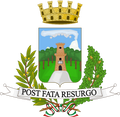
Torre del Greco — Castellesi
CASTELLESI COMUNE
Napoli, Campania
A seafaring town where the right record may be naval, not military.
Torre del Greco — triptych-wide | Wikimedia Commons

Torre del Greco sits directly beneath Vesuvius, between the mountain and the sea, and has been destroyed by it more than once.

It is also the coral capital of the Mediterranean, and a seafaring town of the first rank — which produces a genuine research consequence. A man from Torre del Greco may not appear in the ordinary army conscription lists at all. Seafarers were registered separately, in records kept by a different authority entirely.

Torre del Greco — intro-wide | Wikimedia Commons
The Trade
Coral and cameo
Coral working and cameo carving are Torre del Greco's defining crafts. Coral fished across the Mediterranean was worked here into jewellery, and shell carving developed into an international industry that still survives in local workshops.
The Landmark
Basilica di Santa Croce
Basilica di Santa Croce is the town's principal listed church. For family research, the parish remains important, but occupation may be equally revealing in a place where coral workers and seafarers formed distinct local communities.
Torre del Greco — landmark | Wikimedia Commons
Did you know?
SEAFARERS HAVE DIFFERENT RECORDS

Look beyond the army lists

Men working at sea could appear in the matricole della gente di mare and leva di mare, maintained through the maritime authorities, rather than ordinary army conscription. In a major seafaring town like Torre del Greco, that distinction can be decisive.
LA PARLATA
How they speak

Italian is standard. Local speech may include Campanian and Neapolitan varieties, without naming a narrower Torrese form.

The sea kept its own registers

The town's motto is post fata resurgo — after death I rise again — and it is earned. Torre del Greco sits on the seaward slope of Vesuvius , and the eruption of 1794 destroyed much of it, the lava running through the town and into the sea. It had been damaged before and would be again. Each time it was rebuilt on the same ground, because the ground is extraordinarily fertile and the sea is right there.

What made the town rich was coral . From the eighteenth century Torre del Greco fishermen worked the coral banks of the Mediterranean — off Sardinia, Corsica, Tunisia, Algeria and beyond — in fleets of small boats that were away for months. The town then developed the working of it: coral and shell cameo carving became a craft industry here of international reputation, and remains one, with a school and a museum devoted to it.

That combination — long-distance fishing, shipowning, and a luxury export craft — made Torre del Greco a maritime town in a way its agricultural neighbours were not. Its men went to sea as a matter of course, and many of them ended up in merchant fleets far from Italy.

Torre del Greco — story-01 | Wikimedia Commons
Torre del Greco — story-02 | Wikimedia Commons
Wear Torre del Greco

Carry your heritage with pride. Timeless designs inspired by the heart of Napoli.

SHOP THE COLLECTION →
Where this
belongs
Napoli
PROVINCIA DI NAPOLI

Discover the beauty, culture and traditions of Napoli and its remarkable comuni.

EXPLORE NAPOLI →
REGIONE CAMPANIA

From the mountains to the sea, Campania is a region of history, flavor and soul.

EXPLORE CAMPANIA →

From the passenger index

At least 433 people who gave Torre del Greco as their home are recorded by name among Italian arrivals in the United States — each with the ship they sailed on and the day they landed.

A floor, not a total. The index covers arrivals through 1912, holds nothing between May 1907 and December 1911, and many passengers were written down with no home town at all. Where a name is there, it is there with its record.

Have Orso look for your family →
Ready to visit
Under the mountain, beside the water
Getting there

The nearest major airport is Naples International Airport (Capodichino).

Torre del Greco is a dense working town of some eighty thousand, squeezed between Vesuvius and the sea and largely unvisited. It is not pretty in the way the Sorrentine coast is, and it does not try to be.

For a descendant it is unusually legible. The coral workshops and the museum explain the town's economy directly; the port explains its men; and the lava fields and rebuilt streets explain its relationship with the mountain.

Vesuvius is directly above and reachable from here, and Ercolano, Torre Annunziata and Pompei are all minutes along the coast.

What to see

Museo del Corallo — the coral and cameo collection, and the clearest explanation of what this town did.

The coral and cameo workshops — still operating in the town.

The port — where the coral fleets sailed from, and the Capitaneria that registered their crews.

The Vesuvian villas — the town sits at the southern end of the Miglio d'Oro.

Vesuvius — directly above, with the 1794 lava fields visible on the slope.

Your family's parish — the record-keeping institution before civil registration.

Ercolano, Torre Annunziata and Pompei — all within minutes along the coast.

Family history
Where the records are
Torre del Greco — closing | Wikimedia Commons

Your Roots. Their Story. Your Place.

Torre del Greco is more than a place on a map. It is a part of you.

FIND YOUR COMUNE →