The Patron
San Michele
Michele is Gravina's listed patron, celebrated on 29 September. Local tradition includes the distinctive 8 May devotion at the rock-cut church of San Michele delle Grotte.

 — Castellesi

Gravina stands on the edge of the ravine that gives it its name, in the Alta Murgia inland from Bari. Beneath and around the modern town are roughly eighty rupestrian sites — cave dwellings, crypts and rock-cut churches — and the town above them grew out of that underground world rather than beside it.
For a researcher two things dominate. The Archivio di Stato di Bari holds civil status for 1809 to 1938 with decennial indexes and allegati, and Gravina is named in its list. And before 1809, this was an Orsini fief — held by the Roman family from 1388 to 1816 , four hundred and twenty-eight years under a single house. That continuity is the pre-1809 research route, and it does not run through Puglia.


The local speech is Apulian, Murgian variety of the Barese hinterland.
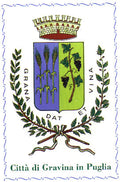
The Greeks are said to have called this place Sidion , the land of pomegranates, and the Romans Silvium , the land of woods. The modern name is usually explained by the ravine itself, though tradition prefers a phrase attributed to Frederick II — Grana dat et vina , it gives grain and wine — from which Gravina is said to derive. The ancient settlement lay on the hill of Botromagno , with the archaeological site known as the Padre Eterno below it.
The town's own origin is a refugee story, and it is written into the rock. The church of San Michele delle Grotte , in the rione Fondovico , was excavated out of a single block of tufa between the eighth and tenth centuries : five naves carried on fourteen natural quadrangular pillars, with Byzantine frescoes. It was, in the local account, the mother church of the refugees , who built their dwellings around it and so brought Gravina into being. Inside it are skulls and bones which tradition assigns to the victims of the Saracen massacre of the Gravinesi in 999 .
Around it lie some eighty rupestrian sites in the ravine — among them the grotta delle sette camere , the crypt of San Vito Vecchio , the Sepulcreto, and the rock sanctuary of the Madonna della Stella , which became a Marian sanctuary in the 1500s and takes its name from a fresco of the Madonna and Child with a star on her forehead.
Above ground, Frederick II built the Castello Svevo as a hunting lodge, the country then being wooded. The cathedral was built in 1065 , almost entirely destroyed by the earthquake of 1456 , and rebuilt from 1482 under Bishop Matteo D'Aquino , supported by the citizens and financed by Duke Francesco II Orsini — the design has been attributed to Bramante . It is now a basilica minore dedicated to Santa Maria Assunta : three naves on columns whose capitals are all different, with polychrome marble altars of the early eighteenth century.
The town's emblem is its bridge, and its history is a lesson in reading dates carefully. The Ponte Acquedotto Madonna della Stella crosses the ravine — anciently the Crapo — ninety metres long, thirty-seven high, five and a half wide. It was built to let the faithful reach the rock sanctuary on the far side. Its original construction date is unknown, but a notarial act proves it existed by 1686 . Destabilised by the earthquake of that year, it probably came down in the 1722 quake. The Orsini then rebuilt it, and did something more than rebuild: they turned it into a true aqueduct , carrying water from the springs of Sant'Angelo and San Giacomo to under the city walls. The double-arcade structure was begun in 1743 and completed in 1778 — the same year as the Quattro Fontane monument, raised to bring water into the town from the Pozzo Pateo spring.
The Orsini left other marks. Santa Maria del Suffragio , the church of the Purgatorio, was built between 1649 and 1654 as the family's funerary chapel. And the Biblioteca Finya , one of the oldest libraries in Puglia, holds more than eight thousand volumes.
One institution predates all of it. The Fiera di San Giorgio , held in April, was restored by Charles of Anjou in 1294 at the instance of the count of Montfort, and Gravina claims it as the oldest fair in the world. It still opens with a historical cortege re-enacting the ceremonies that began the market.


Carry your heritage with pride. Timeless designs inspired by the heart of Bari.
SHOP THE COLLECTION →


Discover the beauty, culture and traditions of Bari and its remarkable comuni.
EXPLORE BARI →From the mountains to the sea, Puglia is a region of history, flavor and soul.
EXPLORE PUGLIA →From the passenger index
At least 408 people who gave Gravina in Puglia as their home are recorded by name among Italian arrivals in the United States — each with the ship they sailed on and the day they landed.
A floor, not a total. The index covers arrivals through 1912, holds nothing between May 1907 and December 1911, and many passengers were written down with no home town at all. Where a name is there, it is there with its record.
Have Orso look for your family →The nearest major airport is Bari Karol Wojtyła Airport.
Gravina is inland from Bari on the Alta Murgia, and the town is best understood from the edge of its ravine.
Start in the rione Fondovico at San Michele delle Grotte — a five-naved church cut from one block of tufa, its fourteen rock pillars still carrying the roof, its Byzantine frescoes and its bones. This is where the town began.
Then walk the last surviving stretch of the sixteenth-century walls from the Sant'Andrea quarter out onto the Ponte Acquedotto Madonna della Stella : ninety metres of double arcade, thirty-seven metres above the gorge, built between 1743 and 1778 by the Orsini to carry water as well as people. On the far side, a path leads to the rock sanctuary of the Madonna della Stella .
In the town, the cathedral — founded 1065, rebuilt after 1456, possibly to a design by Bramante — the Orsini funerary chapel of Santa Maria del Suffragio , the Quattro Fontane of 1778, and the Biblioteca Finya .
And then go down. Gravina Sotterranea runs fifteen metres beneath the streets. In a town whose first inhabitants lived in the rock, the underground is not a curiosity; it is the earlier version of the same place. If you can come in April, the Fiera di San Giorgio opens with the cortege.
Archives and registers
Bari's fond runs 1809-1938 and names the town as Gravina di Puglia - search both spellings. For anything earlier, the Orsini held the fief from 1388 to 1816 and their papers are Roman.
Archivio di Stato di Bari on Antenati
The holdings statement: Atti dello Stato civile 1809-1938 with decennial indexes and allegati, listing the town as Gravina di Puglia, and noting that the leva records are split across the Bari, Barletta and Trani sections.
antenati.cultura.gov.itArchivio di Stato di Bari - research by correspondence
States that the archive is not a civil-status archive and does not do genealogy, that registers 1809-1900 are browsable on Antenati, that staff will search up to three names with full data, and that decennial indexes are unavailable for many comuni.
archiviodistatodibari.cultura.gov.itArchivio di Stato di Bari, Sezione di Trani
The Trani section's 1901-1938 holding for the eleven comuni now in Barletta-Andria-Trani, including the Murgian neighbour Spinazzola.
antenati.cultura.gov.itPonte Viadotto-Acquedotto Madonna della Stella
Local account citing the notarial act that proves the bridge existed by 1686, the collapse after the earthquakes of 1686 and 1722, and the Orsini reconstruction as an aqueduct - with a reference to Nardone's study of the Orsini fief 1388-1816.
gravinaoggi.itAntenati - browse the registers
Confirm which years for Gravina are catalogued and imaged, and check Altamura, Santeramo in Colle and Poggiorsini in the same search.
antenati.cultura.gov.itThe journey does not end at the boundary of one comune. The province, the region and the neighbouring towns often hold the rest of the picture.

Gravina in Puglia is more than a place on a map. It is a part of you.
FIND YOUR COMUNE →