The Patrons
Santi Pietro e Paolo
Rome's patrons are Saints Peter and Paul, whose feast falls on 29 June. The date is the city's own holiday and belongs to Rome's civic and religious calendar rather than merely to its visitor itinerary.

 — Castellesi

Everyone knows Roma. Almost nobody researching an Italian family expects it to be the hardest place in the country to trace one.
The reason is not the size of the city. It is that Roma was not part of Italy for most of the period Italian-American families came from. It was the capital of the Papal States, and the Italian civil registration that makes research possible everywhere else simply does not exist here until 1871. If your family left Rome before then, the entire standard method does not apply.


Romanesco is Rome's local dialect, distinct from standard Italian and from the southern varieties carried by many emigrants. A family's remembered speech can therefore be useful evidence of Roman rather than southern origin.
Rome's ancient history is the most documented in the world and needs no retelling here. What matters for a family search is what happened much later, and it is far less widely known.
After the fall of the western empire Rome became something unusual: a city governed by the Church. For centuries it was the capital of the Papal States, an actual sovereign territory ruled from the Vatican, and the administration of ordinary life — births, marriages, deaths, parish registers, charity, burial — ran through ecclesiastical rather than civil institutions.
That arrangement was interrupted once. Between 1809 and 1814 Napoleonic France annexed Rome, and for a few years the French civil-registration system operated here as it did across the rest of the empire. When Napoleon fell, papal government returned and so did the old way of recording lives.
The final change came in 1870. Italian troops entered Rome through the breach at Porta Pia, the Papal States ended, and the following year Rome became the capital of the Kingdom of Italy. Italian civil registration began. The city then grew enormously and quickly, absorbing people from across central and southern Italy — which is why so many families with a Roman address are not, in the record, Roman in origin.


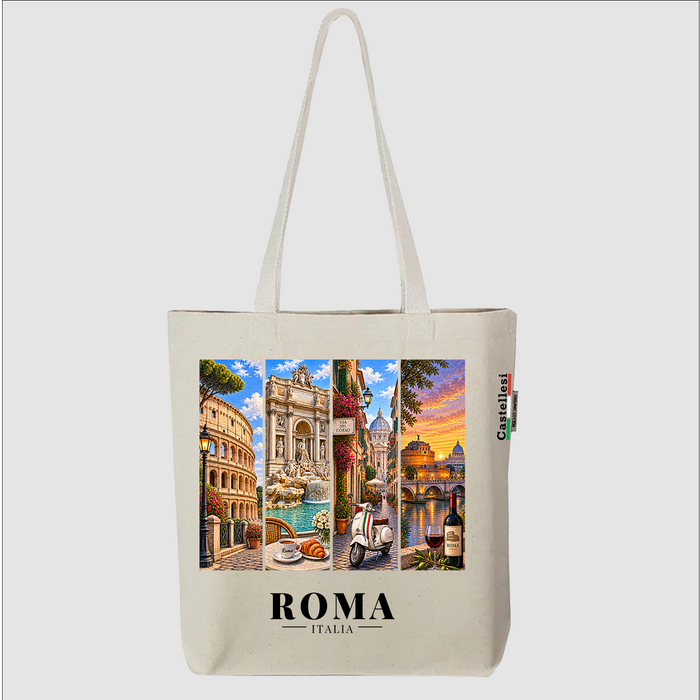
Carry your heritage with pride. Timeless designs inspired by the heart of Roma.
SHOP THE COLLECTION →



Discover the beauty, culture and traditions of Roma and its remarkable comuni.
EXPLORE ROMA →From the mountains to the sea, Lazio is a region of history, flavor and soul.
EXPLORE LAZIO →From the passenger index
At least 4,748 people who gave Roma as their home are recorded by name among Italian arrivals in the United States — each with the ship they sailed on and the day they landed.
A floor, not a total. The index covers arrivals through 1912, holds nothing between May 1907 and December 1911, and many passengers were written down with no home town at all. Where a name is there, it is there with its record.
Have Orso look for your family →The nearest major airport is Rome Fiumicino or Rome Ciampino.
Rome is the most visited city in Italy and the least likely to be seen. A descendant has a reason to do it differently.
The monuments will be there and are worth the time. But the trip that matters is the one built around the rione, the parish and the street your research has produced. Trastevere, Monti, Testaccio and the other districts of the historic centre are living neighbourhoods with churches, markets and daily routines, and they are where a Roman family's life actually happened.
If your family were in Rome before 1870, the church that holds their records may still be standing and still in use. Attending a Mass in the parish where a great-grandparent was baptised is a different experience from queueing for a basilica.
Your parish — the one from the records. In Rome this is the single most meaningful address a descendant can have.
Your rione — Trastevere, Monti, Testaccio, Regola, Sant'Angelo and the rest. Each has its own character, and Romans still identify by them.
Porta Pia — the breach through which Italian troops entered in 1870, ending papal rule and beginning the civil records that make later research possible.
The Ghetto and Sant'Angelo — the old Jewish quarter, one of the oldest continuously inhabited Jewish communities in Europe, with its own cuisine and its own records.
Testaccio market — an ordinary working market rather than a display, and a good place to understand Roman food as food.
Campo Verano — the monumental cemetery, if your research has produced burials.
Archives and registers
Before 1871 Rome kept no Italian civil registers. Research begins at the diocesan archive.
Find the Rome archive on Antenati
Reach the Archivio di Stato di Roma from the map or list — for the Napoleonic civil status of Rome and its circondario, 1810–1814, and the Italian civil status from 1871.
antenati.cultura.gov.itWhy the dates differ across Italy
Antenati's explanation of the systems, including the Restoration gap in papal territory that runs latest of all in Rome.
antenati.cultura.gov.itThe journey does not end at the boundary of one comune. The province, the region and the neighbouring towns often hold the rest of the picture.

Roma is more than a place on a map. It is a part of you.
FIND YOUR COMUNE →