The Patron
Sant'Ambrogio
Sant'Ambrogio is Milan's patron, celebrated on 7 December. His feast coincides with the Oh Bej! Oh Bej! Market and the traditional opening night of La Scala, making it a defining date in the city's own calendar.

 — Castellesi

Milan has been Roman capital, Lombard duchy, Visconti and Sforza state, Spanish possession, Austrian province, Napoleonic capital and Italian industrial city.
For a family researcher one fact matters above the rest: for the century before 1866, the registers of births, marriages and deaths for Milan and the surrounding comuni are held by the diocese , not by the State Archive. If you write to the wrong one, the answer is that they do not have it — which is true, and misleading.


Italian is standard, while local speech may include Lombard varieties. It does not provide a narrower dialect label for the city itself.
Milan was Mediolanum , capital of the western Roman Empire in its later years, and it was here in 313 that the Edict of Milan granted toleration to Christianity. Its bishop Ambrose , in the fourth century, gave the city a religious identity so distinct that Milan still uses its own liturgy — the Ambrosian Rite — with a different calendar and different observances from the Roman one. That is not a curiosity for a researcher: it shaped how the Milanese church organised itself and kept its books.
After the medieval commune came the Visconti and then the Sforza , who made Milan one of the great courts of Renaissance Europe. Foreign rule followed — Spanish from the sixteenth century, then Austrian from 1706. The Austrian period was long and consequential: under Maria Theresa and Joseph II, Lombardy was reorganised, surveyed and administered with a thoroughness that produced excellent records, including the cadastral survey that still bears Maria Theresa's name.
Napoleon made Milan the capital of the Cisalpine Republic and then of the Kingdom of Italy from 1805 to 1814. Austria returned in 1815 and held Lombardy until 1859 , when it passed to Piedmont, and Italy followed in 1861.
Then the factories. Milan industrialised earlier and harder than anywhere else in Italy, and it pulled in workers from the countryside and eventually from the whole peninsula. The Milan a twentieth-century family left, or arrived in, was an industrial city.


Carry your heritage with pride. Timeless designs inspired by the heart of Milano.
SHOP THE COLLECTION →


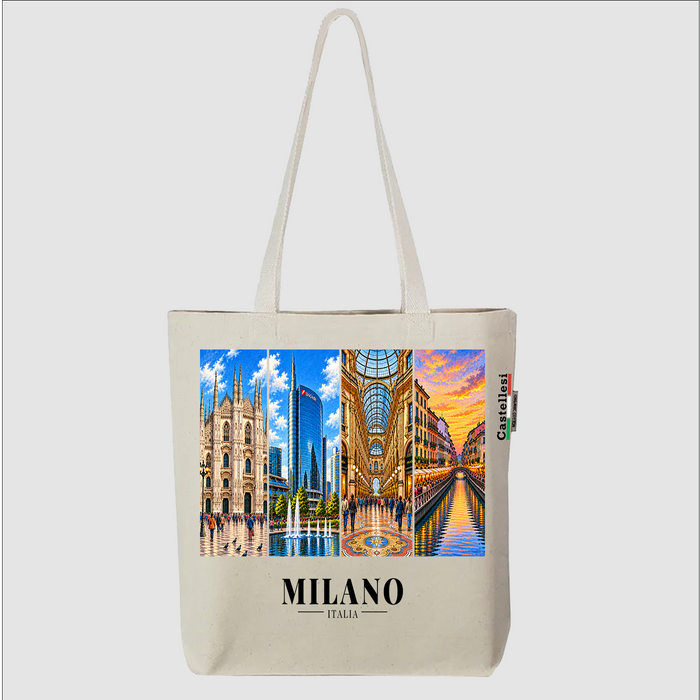
Discover the beauty, culture and traditions of Milano and its remarkable comuni.
EXPLORE MILANO →From the mountains to the sea, Lombardia is a region of history, flavor and soul.
EXPLORE LOMBARDIA →From the passenger index
At least 2,579 people who gave Milano as their home are recorded by name among Italian arrivals in the United States — each with the ship they sailed on and the day they landed.
A floor, not a total. The index covers arrivals through 1912, holds nothing between May 1907 and December 1911, and many passengers were written down with no home town at all. Where a name is there, it is there with its record.
Have Orso look for your family →The nearest major airport is Milan Malpensa or Milan Linate.
Milan presents itself as modern, and visitors take it at its word. A descendant should look for the older city underneath, which is still there in pieces.
Sant'Ambrogio is a fourth-century foundation. San Lorenzo has Roman columns standing outside it. The Duomo took six centuries. And the ordinary residential quarters — the ones with a parish church on a small square — are where Milanese families actually lived.
If your family arrived in Milan as workers rather than being from the city, the industrial belt is their Milan: Sesto San Giovanni, Bovisa, the areas around the old factories. That is a real heritage landscape even though nobody puts it on a postcard.
And if they came from the province or the wider Lombard plain, those towns are close and easy — Monza, Lodi, the Navigli countryside, the lakes an hour north.
Basilica di Sant'Ambrogio — founded by the patron himself in the fourth century, and the heart of the Ambrosian tradition.
Your family's parish church — the institution that kept the record for the whole pre-1866 period.
Archivio storico diocesano , via San Calimero — where the 1770–1865 registers are.
Il Duomo — six centuries in the building, and the marble brought in by canal.
The Navigli — what remains of the canal system that made Milan a port.
Sesto San Giovanni and the industrial belt — if your family came to Milan for work.
Monza — with the Duomo and the iron crown of the Lombard kings.
Archives and registers
Milan's pre-1866 records are diocesan, not civil. And Mantova follows a different date from the rest of Lombardy.
Find the Milan archive on Antenati
Reach the Archivio di Stato di Milano from the map or list.
antenati.cultura.gov.itWhy the dates differ across Italy
Antenati's explanation of the systems. Mantova was legislatively unified with the Venetian provinces from 1 September 1871, so it does not share Lombardy's 1866 date.
antenati.cultura.gov.itThe journey does not end at the boundary of one comune. The province, the region and the neighbouring towns often hold the rest of the picture.

Milano is more than a place on a map. It is a part of you.
FIND YOUR COMUNE →