

Lombardia
Austrian Records, Italian Provinces
Lombardy is Italy's most populous region, its industrial engine, and — for most of the period a family researcher cares about — Austrian territory.
That matters more than it sounds. The records look different from southern Italian ones, the parish rather than the state often holds them, and one Lombard province follows a completely different timetable from the other eleven.
Your roots
Twelve provinces, and one that behaves differently
No record was filed under "Lombardia." The narrowing runs region → province → comune → parish, and here the parish carries more weight than it does in the south.
Find the province. Lombardy has twelve: Milano, Bergamo, Brescia, Como, Cremona, Lecco, Lodi, Mantova, Monza e Brianza, Pavia, Sondrio and Varese. Three of them are recent creations, covered below.
Then the comune, and then the parish — which in Lombardy is often where the record physically is, not merely where it originated.
American records get you there: manifests, naturalisation papers, census returns, draft registrations, the receiving parish.
Two cautions specific to this region.
Lombard emigration often did not go to America. Or not only. Lombards went in large numbers to France, Switzerland, Germany, Belgium and South America, frequently seasonally and frequently returning. An ancestor who worked abroad for years may leave no American trace at all.
Milan drew people in. It industrialised early and pulled workers from the Lombard countryside, then the Veneto, then the south. A family recorded in Milan may have arrived a generation earlier from elsewhere entirely.
Narrow it down
The provinces of Lombardia
A province is where the State Archive sits and where the historic district series were filed. If you know yours, it is the fastest way in.
The region
Lombards, Spaniards, Austrians, factories
The region takes its name from the Longobardi, the Germanic people who ruled much of Italy from the sixth century with their capital at Pavia. Before them it was Roman Cisalpine Gaul; Milan was an imperial capital, and the Edict of Milan of 313 was issued here.
The medieval communes — Milan, Bergamo, Brescia, Cremona, Pavia, Como — were among the wealthiest in Europe, and their rivalries shaped the region's fragmented identity. The Visconti and then the Sforza built the Duchy of Milan into a great Renaissance state.
Foreign rule followed for three centuries: Spanish from the sixteenth century, then Austrian from 1706. The Austrian period is the one that shaped the records. Under Maria Theresa and Joseph II, Lombardy was surveyed, reorganised and administered with unusual thoroughness — the Teresian cadastre is still a research source.
Napoleon made Milan capital of the Cisalpine Republic and then of the Kingdom of Italy, 1805–1814. Austria returned in 1815, ruling Lombardy as part of the Kingdom of Lombardy-Venetia until 1859, when it passed to Piedmont and then to the new Kingdom of Italy.
Then industry, on a scale nothing else in Italy matched — textiles, steel, engineering, and the migration into the cities that came with it.
Culture & traditions
A region with its own liturgy
Lombardy has no single patron and no single dialect, but it has something no other Italian region has.
The Ambrosian Rite. The archdiocese of Milan and part of the surrounding territory follow their own liturgical rite, distinct from the Roman — a different calendar, a different Lent, a different order of service. For a researcher this is practical, not decorative: dates that look wrong against the Roman calendar may be right against the Ambrosian one, and the Milanese church's own organisation follows from it. Note that not all Lombard dioceses are Ambrosian; Bergamo, Brescia and others follow the Roman rite.
Language divides the region. Lombard splits into western varieties around Milan, Como and the Brianza, and eastern ones around Bergamo and Brescia, and the two are not easily mutually intelligible. In parts of the Valtellina, in Sondrio province, the speech relates to Romansh across the Swiss border.
Patron feasts are local. Sant'Ambrogio on 7 December is Milan's, and Milan's alone — it is not a Lombard feast.
The table is northern. Rice rather than pasta in much of the region — risotto, and the paddy fields of the Lomellina. Butter rather than oil. Polenta, cured meats, mountain cheeses from the Valtellina and the Bergamasque valleys, panettone at Christmas. If your family's cooking was rice-and-butter rather than pasta-and-oil, that is a northern origin marker.
Provinces
Milano · Bergamo · Brescia · Como · Cremona · Lecco · Lodi · Mantova · Monza e Brianza · Pavia · Sondrio · Varese
Historic areas
Duchy of Milan · Kingdom of Lombardy-Venetia · Brianza · Valtellina · Oltrepò Pavese · the lakes
Languages & dialects
Lombard, in western and eastern varieties — Milanese, Brianzolo, Bergamasco, Bresciano; also Romansh-related speech in parts of Sondrio
Regional traditions
The Ambrosian Rite in the Milan diocese; patron feasts by town elsewhere
Where the records are
The diocese often holds it — and Mantova follows a different clock
Three things distinguish Lombard research, and the third catches almost everyone.
Diocesan archives hold the pre-unification registers
In Lombardy the century before unification is frequently the diocese's territory, not the State Archive's. For Milan and the comuni of the Ambrosian diocese, the birth, marriage and death registers for 1770–1865 are held at the Archivio storico diocesano of Milan, not the Archivio di Stato. Other Lombard dioceses hold comparable material. Before 1770, the parish archives.
This is why a researcher writing to a State Archive for an 1840 Lombard birth is told, correctly, that it is not there.
What an Austrian-period act looks like
The Restoration-period records of Lombardy and the Veneto are the Austrian civil status, registered through the Ministry of Worship and then deposited with the comuni. They differ from southern acts in two ways worth knowing before you read one: the baptismal record appears on the same document as the civil registration, and marginal annotations are rare. Do not expect the later-life marriage or death notes that a southern birth act usually carries in its margin.
Mantova is on the Veneto timetable, not Lombardy's
This is the correction. Lombardy passed to Italy in 1859, and Italian civil registration applies from 1 January 1866 as it does nationally.
But Mantova was not part of that. It remained Austrian with the Veneto until 1866, and the legislative unification of the Venetian provinces and that of Mantua with the rest of the kingdom began on 1 September 1871. For Mantova, civil registration and the anagrafe date from then — five years later than the rest of Lombardy.
So a researcher applying the Lombard rule to a Mantovan family will look in the wrong place for those years.
Three provinces that did not exist
Lecco and Lodi were both created by decree of 6 March 1992, becoming operational in 1995. Lecco was assembled from 84 comuni of Como province and 6 of Bergamo; Lodi from territory of Milan province.
Monza e Brianza was created in 2004 and became operational in 2009, from territory of Milan province.
So for any record before those dates, a comune now in Lecco, Lodi or Monza e Brianza was in Como, Bergamo or Milano province. Historical holdings follow the older arrangement.
After 1866
Each comune holds its own registers. The Archivio di Stato di Milano holds the civil status 1866–1946 deposited by the tribunal, and the Milan comune's own registers are also at the Archivio Storico Civico in the Castello Sforzesco. Note the State Archive's caution that comunal registers have large gaps where natural disasters occurred.
Visit the region
Plain, lakes and mountains
Lombardy divides into three bands. The Po plain in the south — flat, agricultural, foggy in winter, with the old communal cities strung across it. The lakes and prealps in the middle — Como, Maggiore, Iseo, Garda. And the Alps in the north, in Sondrio province and the Valtellina.
It is also the easiest Italian region to move around. Motorways and trains are dense, and most comuni are within an hour or two of Milan.
Most visitors see Milan and the lakes. A descendant's Lombardy may be a plain town in Cremona or Pavia province, a valley village above Bergamo, or an industrial suburb — none of them on a tourist route, and all of them easy to reach.
The areas of the region
Milano — the Duomo, Sant'Ambrogio, the Navigli, and the diocesan archive that holds the pre-1866 registers.
The lakes — Como, Maggiore, Iseo and Garda, with the towns and villages along them.
The communal cities — Bergamo Alta, Brescia, Cremona with its violin workshops, Mantova, Pavia with its Certosa.
The Franciacorta and the Oltrepò Pavese — the wine country south and east.
The Valtellina — the alpine valley in Sondrio province, with its terraced vineyards and mountain cheeses.
Monza — the Duomo and the iron crown of the Lombard kings.
Your family's comune — in a region of over 1,500 comuni, the only real destination.
Wear your roots
Lombardia is part of where you come from.
You can identify with a region even before you have found the town. Explore Castellesi pieces created around this place.

Lombardia Strade d’Italia Left Chest Hoodie
$70.00

Lombardia Strade d’Italia Left Chest Sweatshirt
$55.00
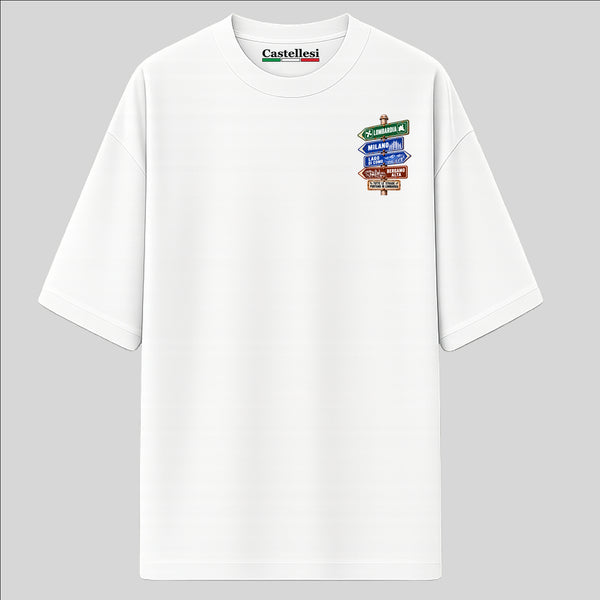
Lombardia Strade d’Italia Left Chest T-Shirt
$30.00
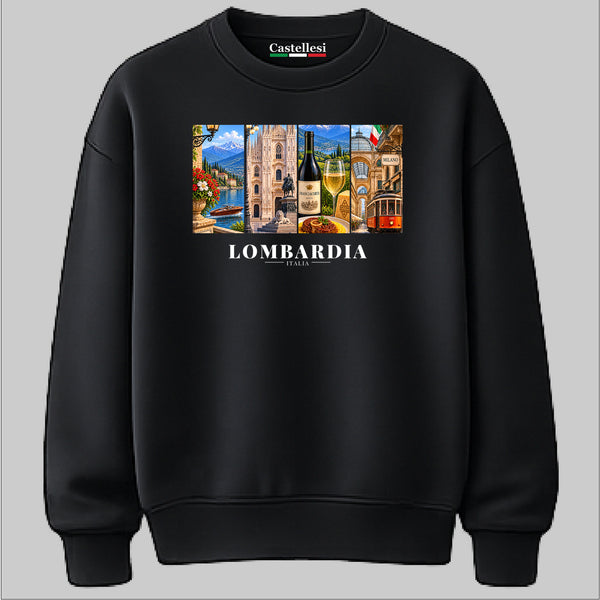
Lombardia Cartoline Sweatshirt
$55.00
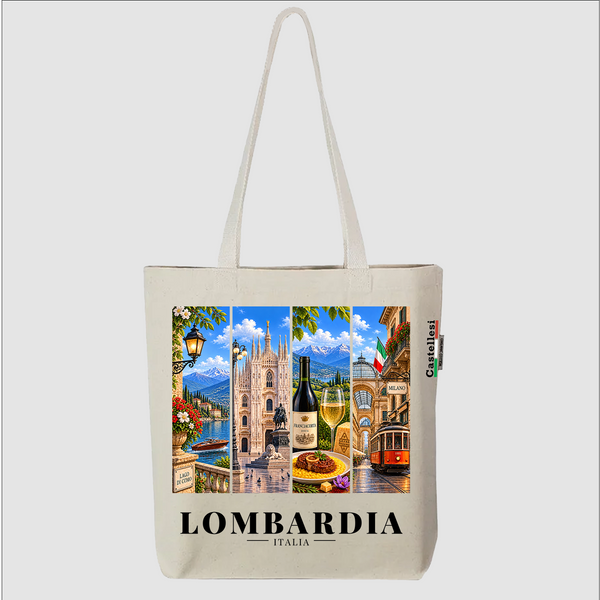
Lombardia Cartoline Tote
$20.00
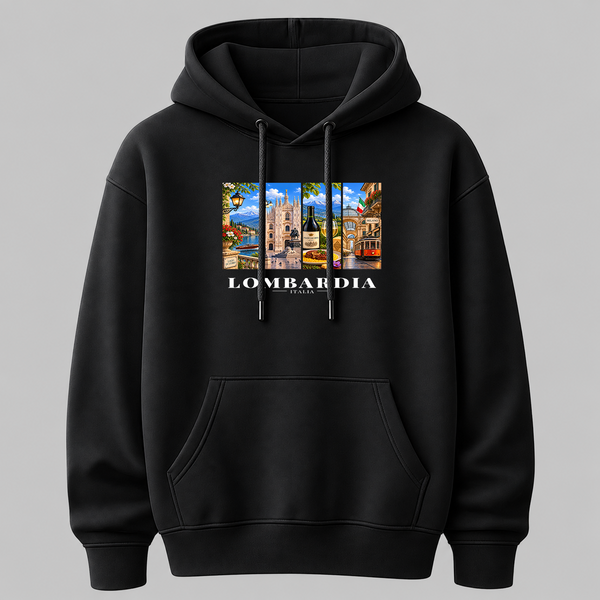
Lombardia Cartoline Hoodie
$70.00
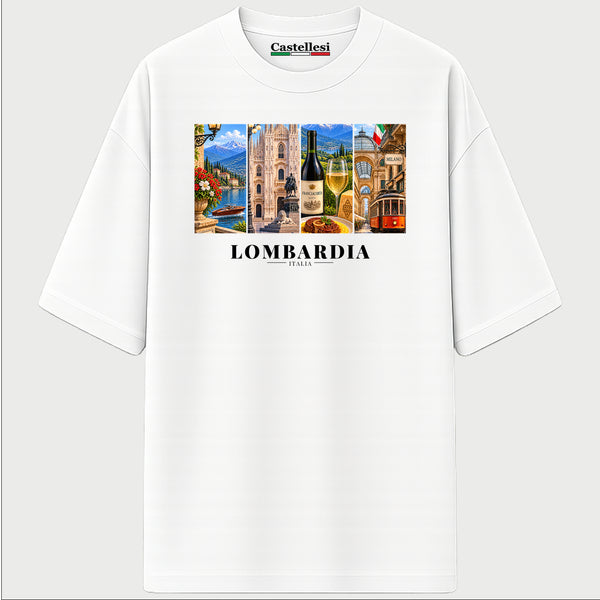
Lombardia Cartoline T-Shirt
$30.00