

Calabria
Two Calabrias, Then Three, Then Five
Calabria is the toe of Italy — mountainous, with two coastlines, and more thinly connected than any other southern region.
Its administrative map has been redrawn repeatedly, and twice in ways that will send a researcher to the wrong archive. Two of its five provinces did not exist before 1992, and the province names in nineteenth-century records are not the ones on today's map at all.
Your roots
Which province, in which century?
No record was ever filed under "Calabria." There is no Calabrian archive. The narrowing runs like this, and here the second step carries a trap.
Find the province — but the right one for the period. Calabria today has five: Cosenza, Catanzaro, Reggio Calabria, Crotone and Vibo Valentia. In the nineteenth century it had three, under different names. The records section below sets out which is which.
Then find the comune. In a region of small mountain towns this is everything, and it is often the only thing that will narrow a common Calabrian surname.
Then, for anything before 1809, the parish.
American records are what get you there — manifests, naturalisation papers, census returns, draft registrations, the receiving parish.
Two clues work especially well in Calabria.
Arbëreshë origin. Numerous Calabrian comuni were settled by Albanians from the fifteenth century and still speak Arbëreshë, some following the Italo-Albanian Byzantine rite. If your family's surname, speech or rite was unusual for a Calabrian family, that is a strong marker pointing to a specific set of towns rather than a confusion.
Mountain or coast. The Sila, the Pollino, the Serre and the Aspromonte are different worlds from the Tyrrhenian and Ionian shores, and families rarely moved between them.
Narrow it down
The provinces of Calabria
A province is where the State Archive sits and where the historic district series were filed. If you know yours, it is the fastest way in.
Explore the comuni
Comuni in Calabria
Each of these has its own story, its own records and its own history. If one of them is your family's, start there.
Acri
Amantea
Castrovillari
Catanzaro
Corigliano-Rossano
Cosenza
Crotone
Gerace
Lamezia Terme
Locri
Palmi
Paola
Pizzo
Reggio Calabria
Rende
Scalea
Scilla
Siderno
Tropea
Vibo Valentia
The region
Magna Graecia, and a long isolation
Calabria was the heart of Magna Graecia. Sybaris, Croton, Locri and Rhegion were among the wealthiest Greek cities in the western Mediterranean — Croton was home to Pythagoras and to the most famous athletes of the ancient games. The Riace Bronzes, recovered from the sea off this coast, belong to that world.
After Rome came Byzantines, Arabs, Normans, Swabians, Angevins, Aragonese and Spanish. Greek was still spoken in parts of Calabria into the Middle Ages and survives in the Griko communities of the far south. From the fifteenth century, Albanian refugees settled dozens of villages, where their language is still living.
What shaped modern Calabria more than any conquest was geography and neglect. The mountains made internal movement hard, the coasts were malarial for centuries, and the region remained among the poorest in the Kingdom of Naples and then in Italy. Earthquakes struck repeatedly — 1783 devastated the south of the region, and 1908 destroyed Reggio and Messina.
Administratively, the Bourbons divided Calabria into Calabria Citeriore, Calabria Ulteriore Prima and Calabria Ulteriore Seconda. Those are the names a nineteenth-century record will carry.
Culture & traditions
Three languages, and devotions that name a town
Calabria has no single patron, no single dialect and no single tradition. What it has, unusually, is three living languages, and each one identifies a specific group of comuni.
Calabrese varies so much between the north and the south of the region that speakers from the two ends struggle with each other. The northern varieties lean toward Neapolitan, the southern toward Sicilian.
Arbëreshë is spoken in dozens of comuni settled by Albanians from the fifteenth century. Several follow the Italo-Albanian Byzantine rite, which means parish records may sit in a different ecclesiastical structure entirely — a fact that has stopped researchers who assumed the Latin rite.
Griko, a Greek variety, survives in the far south of the region.
Patron saints identify towns. San Francesco di Paola, born in Paola on this coast, is patron of Calabria as a whole and of Italian seafarers — one of the few genuinely regional devotions in this collection. Beyond him, feasts are local, and a saint's day a family kept usually names their comune.
Food follows the land. 'Nduja from Spilinga, the red onion of Tropea, chillies, pork and cured meats, Sila cheeses and potatoes, bergamot on the Reggio coast. Mountain and coastal cooking differ completely.
Provinces
Cosenza · Catanzaro · Reggio Calabria · Crotone · Vibo Valentia (the last two only since 1992)
Historic areas
Calabria Citeriore · Calabria Ulteriore Prima · Calabria Ulteriore Seconda — plus the Sila, Pollino, Serre and Aspromonte
Languages & dialects
Calabrese, differing sharply north to south; also Arbëreshë in many comuni and Griko in the far south
Regional traditions
Patron feasts by town; Byzantine-rite observance in the Arbëreshë communities
Where the records are
The province in your record is probably not on today's map
Calabria's provinces have been reorganised twice in ways that matter to a family search — once in 1816 and once in 1992.
The nineteenth-century provinces
Under the Napoleonic reform of 8 August 1806 the provinces were created in earnest, and from 1806 to 1816 Calabria Ulteriore had its capital at Monteleone — today Vibo Valentia.
Then, by law n. 360 of 1 May 1816, in force from 1 January 1817, the territory was divided into three:
Calabria Citeriore — capital Cosenza. Districts: Cosenza, Castrovillari, Rossano and Amantea, later Paola.
Calabria Ulteriore Prima — capital Reggio. Districts: Reggio, Gerace and Palmi.
Calabria Ulteriore Seconda, also called Calabria Brezia — capital Catanzaro. Districts: Catanzaro, Monteleone, Nicastro and Cotrone.
Those are the province names a nineteenth-century record will carry. Searching "Reggio Calabria" for an 1840 record means searching a name that did not yet exist in that form.
And the district names have changed too
Monteleone is now Vibo Valentia — renamed Monteleone di Calabria in 1861 and Vibo Valentia in 1928. Cotrone is now Crotone. Nicastro is now part of Lamezia Terme. Older records use the older names.
Two provinces created in 1992
Crotone (decree of 6 March 1992, 27 comuni) and Vibo Valentia (decree of the same date, 50 comuni) were both carved out of the province of Catanzaro. Crotone became operational in 1995.
So for any record before 1992, a comune now in Crotone or Vibo Valentia province was in Catanzaro province — and before 1816, in Calabria Ulteriore. Historical records and archival holdings follow the older arrangement.
Reggio Calabria became a Città metropolitana in 2017, which affects modern correspondence rather than historical records.
The State Archives
Cosenza, with its Section at Castrovillari; Catanzaro; Reggio Calabria, with Sections at Locri and Palmi. Crotone and Vibo Valentia, being recent provinces, do not have the deep historical holdings the older three do — expect their pre-1992 material to sit with Catanzaro.
One source that is not in Calabria at all
The catasto onciario of the later 1700s, which allows household composition to be reconstructed before civil registration, is held for Calabrian comuni at the Archivio di Stato di Napoli.
Continue your research
Two of Calabria's five provinces were created in 1992. For anything earlier, the records are Catanzaro's.
Browse the Catanzaro civil registers on Antenati
Holds the 1809–1865 civil status for the comuni of Catanzaro AND of the present provinces of Crotone and Vibo Valentia, plus military records for all three.
antenati.cultura.gov.itBrowse the Reggio Calabria civil registers on Antenati
Civil status 1809–1944 — but note the coverage narrows by period, and the Palmi circondario registers have never been deposited.
antenati.cultura.gov.itBrowse the Naples civil registers on Antenati
The catasto onciario for Calabrian comuni is held at NAPLES, not in Calabria — the main pre-1809 source for household composition.
antenati.cultura.gov.itFind any Italian State Archive
For Cosenza, whose digitised presence on Antenati is small — contact the archive or its Castrovillari Section directly.
antenati.cultura.gov.itAn archive record and an online family tree will often disagree. Why family trees disagree, and what settles it →
Visit the region
Mountains between everywhere
Calabria is long, narrow and vertical. The motorway runs down the Tyrrhenian side; the Ionian coast is served by a slower road and a slower railway; and the mountains in between are crossed by a handful of passes.
So distances deceive. A comune in the Sila or the Aspromonte may be an hour from a coast that looks adjacent on the map, and crossing from the Tyrrhenian to the Ionian side takes real time.
Most visitors see Tropea and the beaches. A descendant's Calabria is far more often a hill town — quiet, emptied by emigration, and almost entirely unvisited. Those towns are the trip.
Build the journey around your comune and the coast nearest to it, not around the region.
The areas of the region
Reggio Calabria and the strait — the Riace Bronzes at the archaeological museum, and Sicily across the water.
The Pollino — the great national park on the Basilicata border, and the Arbëreshë villages around it.
The Sila — the high forested plateau, its lakes, cattle and timber country.
The Tyrrhenian coast — Tropea, Pizzo, Scilla, Paola with its sanctuary of San Francesco.
The Ionian coast and Magna Graecia — Locri, Crotone, Sibari and the museums that hold what is left of the Greek cities.
The Aspromonte — the southern massif, and the Griko villages on its slopes.
Serra San Bruno — the Carthusian monastery in the Serre.
Your family's comune — in a region of more than four hundred, this is the only destination that matters.
Wear your roots
Calabria is part of where you come from.
You can identify with a region even before you have found the town. Explore Castellesi pieces created around this place.

Calabria Cartoline Sweatshirt
$55.00
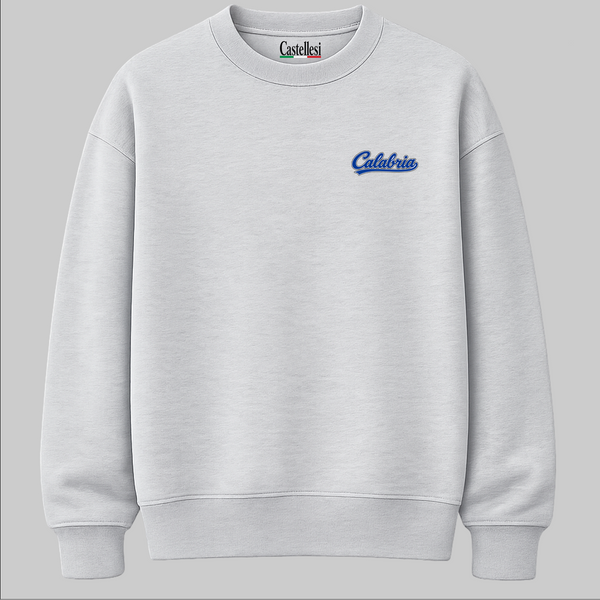
Calabria Varsity Left Chest Sweatshirt
$55.00

Calabria Strade d’Italia Left Chest Hoodie
$70.00

Calabria Strade d’Italia Left Chest Sweatshirt
$55.00
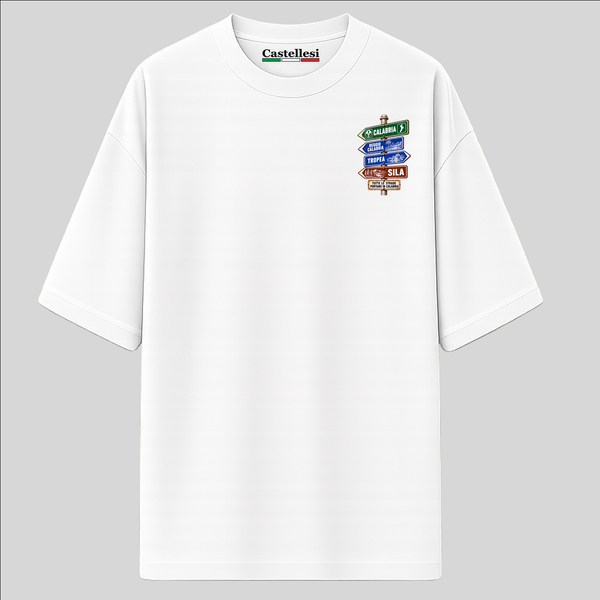
Calabria Strade d’Italia Left Chest T-Shirt
$30.00
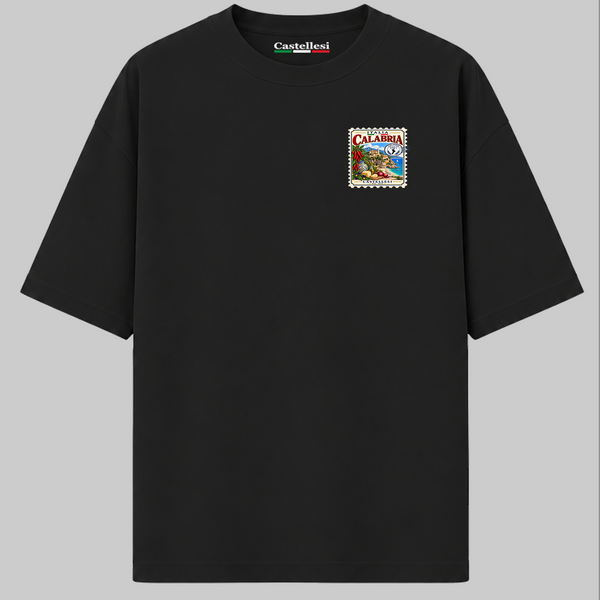
Calabria Francobolli d’Italia T-Shirt
$30.00

Calabria Francobolli d’Italia Tote
$20.00
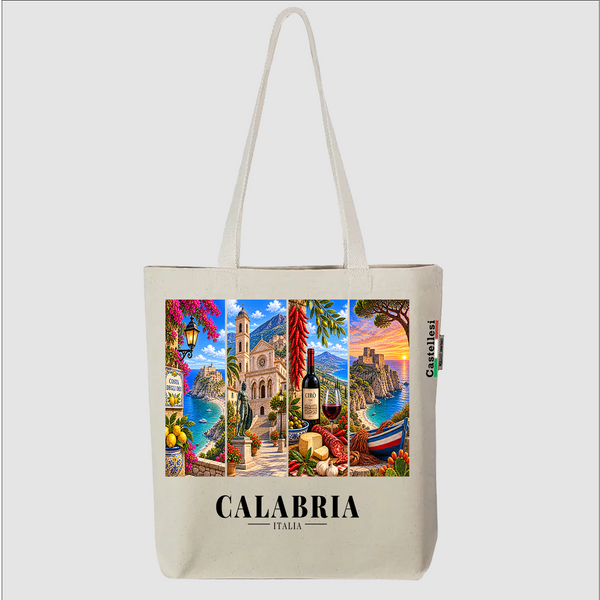
Calabria Cartoline Tote
$20.00