

Abruzzo
Why It Was Called "the Abruzzi"
Abruzzo is the most mountainous region in peninsular Italy — the Gran Sasso, the Majella, three national parks — with a short Adriatic coast and a great deal of high, empty country behind it.
Older documents call it the Abruzzi, in the plural, and that plural is a genuine clue: for centuries this was not one province but two, then three, then four. One of today's four provinces did not exist before 1927, and a stretch of what was Abruzzo is now in Lazio.
Your roots
Four provinces now, three before 1927
No record was filed under "Abruzzo." The narrowing runs region → province → comune → parish, and the province step is where this region's traps sit.
Find the province — for the right period. Abruzzo today has four: L'Aquila, Chieti, Pescara and Teramo. In the nineteenth century it had three, under different names, and Pescara did not exist. The records section sets it out.
Then the comune. Abruzzo is a region of small mountain towns, many of which have lost most of their population, and the comune is the only thing that will narrow a common surname.
Then, for anything before 1809, the parish.
American records get you there — manifests, naturalisation papers, census returns, draft registrations, the receiving parish.
Two cautions.
Check whether your comune is still in Abruzzo. Several comuni that were Abruzzese until 1927 are now in Lazio. Named below.
And whether your family said "Abruzzi e Molise." Until 1963 Abruzzo and Molise were a single region, so a family from Campobasso or Isernia may have described themselves in terms that include Abruzzo.
Explore the comuni
Comuni in Abruzzo
Each of these has its own story, its own records and its own history. If one of them is your family's, start there.
Atri
Avezzano
Chieti
Giulianova
L'Aquila
Lanciano
Montesilvano
Ortona
Pescara
Sulmona
Tagliacozzo
Teramo
Vasto
The region
A justiciarship, two Abruzzi, and the mountains
In antiquity this was the country of the Italic peoples — Marsi, Peligni, Vestini, Marrucini — who fought Rome hard before joining it. Corfinio, briefly, was the capital of the Italic confederation that opposed Rome in the Social War.
The region acquired a single identity in 1233, when Frederick II created the Giustizierato d'Abruzzo with its seat at Sulmona — L'Aquila did not yet exist, being founded in 1254.
Under the Angevins the justiciarship was split in two along the Aterno-Pescara river: Abruzzo Ulteriore to the north and Abruzzo Citeriore to the south. That division lasted more than five centuries, and it is why the region was called gli Abruzzi, in the plural — a usage that survived into the Italian Constitution.
In 1806, under Joseph Bonaparte, Abruzzo Ulteriore was itself divided: Abruzzo Ulteriore Primo with its capital at Teramo, and Abruzzo Ulteriore Secondo at L'Aquila. With Abruzzo Citeriore at Chieti, that made three provinces — four, if you count the Contado di Molise, which was administered alongside them.
The mountains shaped everything else: transhumance down the tratturi to the Puglian plain, isolation, poverty and, from the nineteenth century, heavy emigration. The 1915 Avezzano earthquake and the 2009 L'Aquila earthquake are the two modern catastrophes.
Culture & traditions
Sheep roads, saints and a mountain table
Abruzzo has no single patron and no single dialect. What it has is a shared way of life shaped by mountains and by the movement of flocks.
The tratturi. For centuries Abruzzese shepherds drove their flocks down the great grass droving roads to winter on the Tavoliere in Puglia, returning in spring. Whole families lived by this rhythm. If your ancestors were shepherds, they were seasonal migrants long before anyone emigrated to America — and their names may appear in Puglian records as well as Abruzzese ones.
Patron feasts are local, as everywhere. L'Aquila's Perdonanza Celestiniana, the pardon instituted by Pope Celestine V in 1294, is the region's most distinctive religious observance and is UNESCO-recognised.
Language divides along the mountains. The Adriatic varieties differ noticeably from the Aquilano of the western highlands.
The table is pastoral. Lamb and mutton, pecorino, saffron from Navelli, arrosticini skewers, maccheroni alla chitarra, and Montepulciano d'Abruzzo. Chilli and garlic more than tomato. It is mountain food, and it travelled.
Provinces
L'Aquila · Chieti · Teramo · Pescara (Pescara only since 1927)
Historic areas
Abruzzo Citeriore · Abruzzo Ulteriore Primo · Abruzzo Ulteriore Secondo — plus Marsica, Peligna, Gran Sasso, Majella
Languages & dialects
Abruzzese, in Adriatic and inland varieties; the Aquilano of the west differs markedly from the coast
Regional traditions
Patron feasts by town; transhumance along the tratturi; the Perdonanza of L'Aquila
Where the records are
A province created, and comuni that left the region
Three changes shape where Abruzzese records sit, and two of them happened in a single year.
The nineteenth-century provinces
From 1806 until unification and beyond, Abruzzo was three provinces:
Abruzzo Citeriore — capital Chieti.
Abruzzo Ulteriore Primo — capital Teramo.
Abruzzo Ulteriore Secondo — capital L'Aquila.
Those are the names on a nineteenth-century record. Alongside them, the Contado di Molise with its capital at Campobasso was administered as a fourth province of the same group.
Pescara did not exist before 1927
The province of Pescara was created in 1927, assembled from three existing provinces:
from Teramo, the comuni of the former circondario of Penne, except those of the Bisenti mandamento;
from Chieti, the mandamenti of Manoppello (except Roccamontepiano), San Valentino in Abruzzo Citeriore and Caramanico Terme, together with the comune of Pescara itself;
from L'Aquila, the comuni of Bussi sul Tirino and Popoli.
So for any record before 1927, a comune now in Pescara province was registered under Teramo, Chieti or L'Aquila, and its older archival material follows that older province.
And some Abruzzese comuni are now in Lazio
Also in 1927, the circondario of Cittaducale — some seventeen comuni — was transferred from the province of L'Aquila to the newly created province of Rieti, in Lazio. Among them: Accumoli, Amatrice, Antrodoco, Borbona, Borgo Velino, Cantalice, Castel Sant'Angelo, Cittaducale, Cittareale, Fiamignano, Leonessa, Micigliano, Pescorocchiano, Petrella Salto and Posta.
If your family came from one of those towns, they were Abruzzese in the records until 1927 and Laziali afterwards. Their older records belong to L'Aquila.
Comuni absorbed into L'Aquila
In 1927, under the Grande Aquila measure, eight comuni — Arischia, Bagno, Camarda, Lucoli, Paganica, Preturo, Roio Piano and Sassa — were united with the comune of L'Aquila. Lucoli was reconstituted as an autonomous comune in 1947. Similarly Spoltore was joined to Pescara in 1928 and reconstituted in 1947.
A note on Molise
Until 1963 Abruzzo and Molise formed a single region, Abruzzi e Molise. For the ecclesiastical structure they remain a single region to this day. If your research crosses that border, see the Molise page.
Continue your research
Abruzzo's three historic provinces were redrawn in 1927. Establish which one held your comune before writing to anyone.
Find the Abruzzese State Archives
Reach L'Aquila, Chieti, Teramo or Pescara from the map or list. Before unification the names were Abruzzo Ulteriore Secondo (L'Aquila), Abruzzo Citeriore (Chieti) and Abruzzo Ulteriore Primo (Teramo).
antenati.cultura.gov.itWhy the dates differ across Italy
On the mainland of the former Kingdom of Naples, civil registration begins in 1809 — unlike Sicily, and unlike the northern states.
antenati.cultura.gov.itAn archive record and an online family tree will often disagree. Why family trees disagree, and what settles it →
Visit the region
Mountains, and the towns that emptied
Abruzzo is a short drive from Rome and feels a long way from anywhere. The coast is developed and easy; the interior is high, empty and slow, with passes that close in winter.
For a descendant that emptiness is the point. Many Abruzzese hill towns lost most of their population to emigration and never recovered, and walking one of them is a direct encounter with why your family left.
Base yourself by area — the coast, the Gran Sasso and L'Aquila basin, the Marsica around Avezzano, the Peligna around Sulmona, or the Majella and the Sangro valley.
The areas of the region
L'Aquila — the city rebuilt after 2009, with Santa Maria di Collemaggio and the Perdonanza.
The Gran Sasso and Campo Imperatore — the high plateau, and the highest peak in the Apennines.
Sulmona — seat of the medieval justiciarship, Ovid's birthplace, and the confetti town.
The Majella and the Parco Nazionale — hermitages cut into the rock, including those of Celestine V.
Rocca Calascio and the Marsica — the hill fortresses and the drained bed of the Fucino lake.
The tratturi — the droving roads, still traceable toward Puglia.
The Adriatic coast — Pescara, Vasto, the trabocchi fishing platforms.
Your family's comune — in a region of over three hundred, the only destination that matters.
Wear your roots
Abruzzo is part of where you come from.
You can identify with a region even before you have found the town. Explore Castellesi pieces created around this place.

Abruzzo Strade d’Italia Left Chest Hoodie
$70.00

Abruzzo Strade d’Italia Left Chest Sweatshirt
$55.00
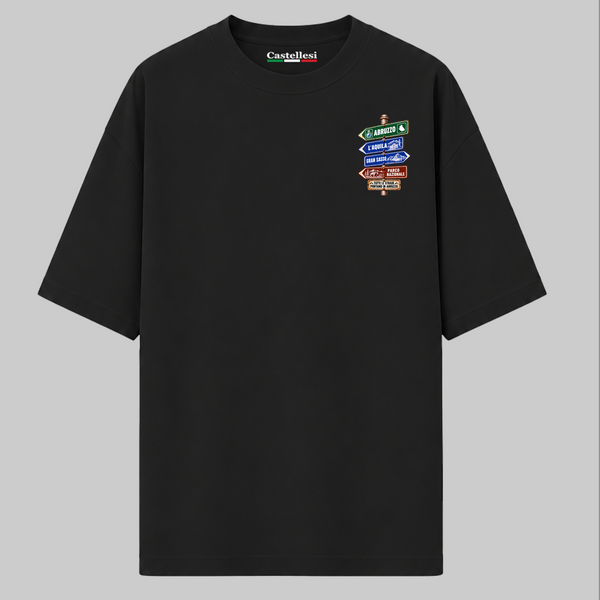
Abruzzo Strade d’Italia Left Chest T-Shirt
$30.00

Abruzzo Orso Sweatshirt
$55.00